Cookie notice

This website uses functional and analytical cookies.

Cookie settings

Below, you can see which types of cookies or similar technologies are used on this site.

Functional cookies

This site uses functional cookies to store cookie settings.

Additional cookies

This website would like to use analytics to better understand its users and improve the site.

This site displays videos and forms from external websites that place cookies.

Accept all cookies
Private credit

Investing in Private Credit

Successful investing is never a matter of luck, it is driven by strategic growth. In a market where traditional returns and stability are under increasing pressure, making a well-considered choice is essential. Invest in Private Credit with BB Capital.
BB Capital - Private-credit-rendement-bb-capital
BB Capital Private Credit

Investing in Private Credit

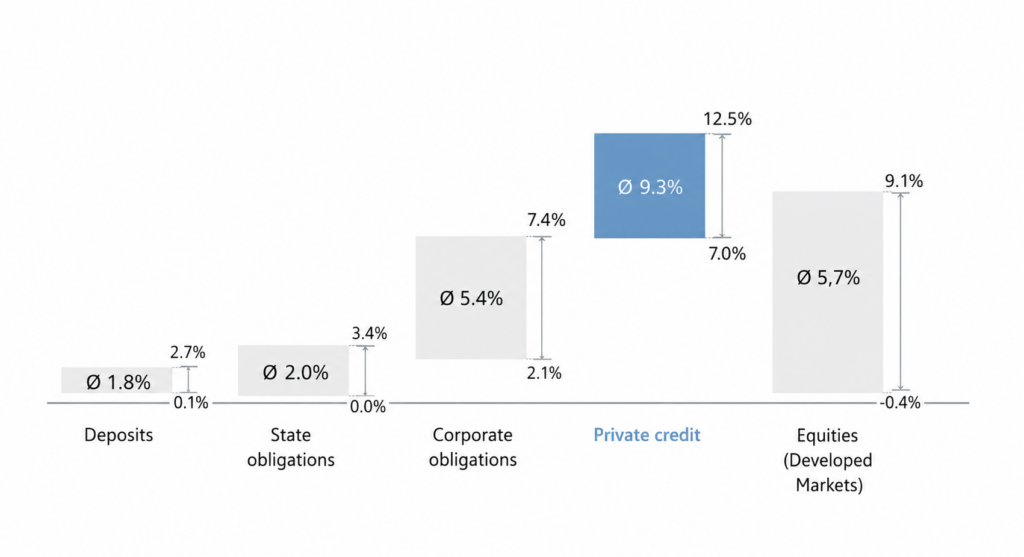
Many investments come with uncertainty. Equities fluctuate unpredictably, while savings generate hardly any return. Without a clear strategy, investors risk losing value or missing attractive opportunities.

A smart choice
Private Credit offers a solid alternative. By providing direct financing to companies without the involvement of banks, this asset class can deliver stable returns of 6–8% per year, without the volatility of equity markets. This makes it a smart choice for investors seeking both growth and a greater degree of certainty.

Invest with insight
At BB Capital, you choose an investment approach based on insight and expertise. Your wealth deserves more than uncertainty; it deserves a well-considered plan for sustainable growth. Invest with insight. Build a strong financial future.
BB Capital - Private-credit-beleggen-bb-capital

Unique open-ended fund structure

BB Capital Private Credit is based on our proven evergreen structure with no fixed term. The benefits:

  • Private Credit is an asset class with stable returns of 6–8% per year, without the volatility of equity markets.
  • You invest in an active investment portfolio, putting your wealth to work from day one.
  • Your capital is fully invested immediately, meaning there are no unexpected capital calls.
  • Returns are distributed quarterly. You can also choose to automatically reinvest your dividend.
BB Capital - Pc broche

Could Private Credit be right for you?

Private credit is funding provided by non-bank lenders rather than traditional banks. While banks often join together to lend to businesses, private credit funds offer direct funding, giving companies a simpler, more flexible alternative.

To summarise the key characteristics of private credit for you:

  • The dynamics of private credit allow for greater liquidity, meaning that both entering and exiting can be simple and efficient.
  • A clearly lower risk profile, given the focus on senior debt instruments with collateral.
  • An attractive fund return, with the expectation that returns will be towards the upper end of this range in the coming period.

All in all, this is a highly attractive proposition and, for good reason, increasingly popular within the private markets segment. It contributes to strong diversification in any portfolio with an allocation to private markets.

Could Private Credit be right for you? Schedule a consultation.

Knowledge

Learn more about Private Credit?

Investing in Private Credit can be done in various ways, depending on the specific structure of the investment and the parties involved.

  1. Direct lending
    Some investors, such as institutional investors or specialised private debt investors, may choose to provide loans directly to companies. This requires in-depth market knowledge and access to companies in need of financing.
  2. Private Credit funds
    Many investors choose to invest through Private Credit funds. These funds are managed by specialised fund managers with expertise in providing loans and managing credit portfolios. Investors purchase participations in the fund, which then uses the capital to provide loans to companies.
  3. BB Capital Private Credit Fund
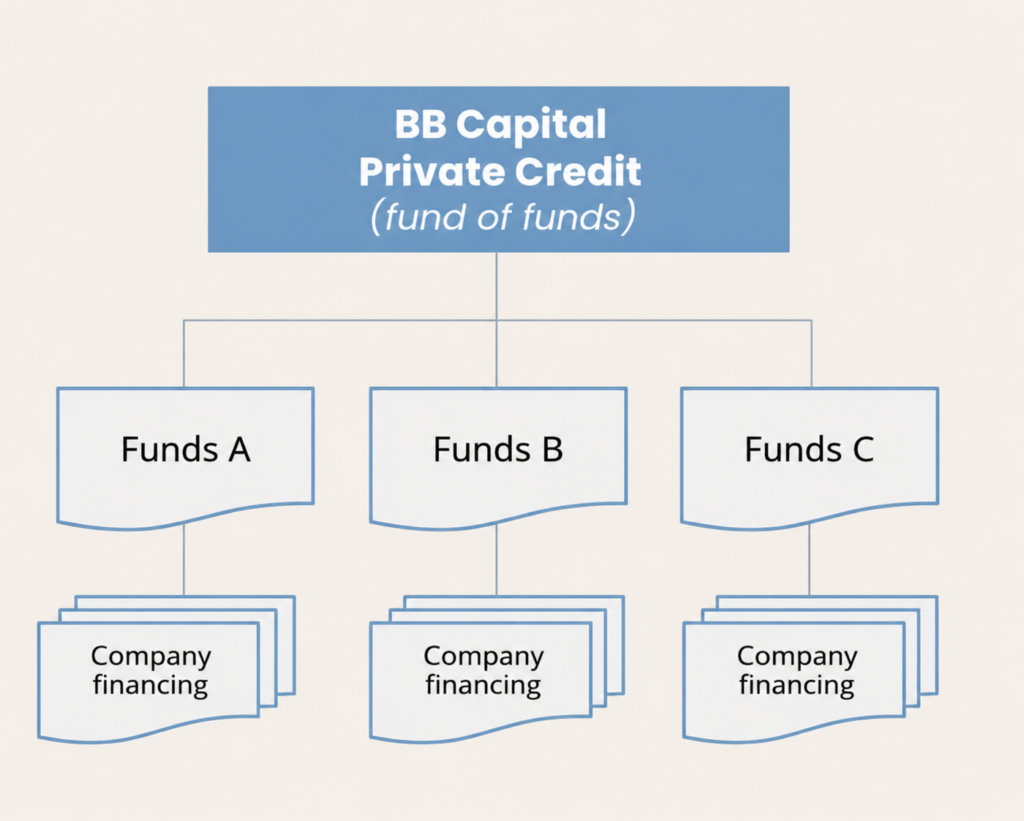
    The BB Capital Private Credit Fund is a fund-of-funds for specialised Private Credit funds, as described above. We select leading Private Credit funds and invest in them through our fund, enabling our investors to invest in a diversified portfolio of carefully selected Private Credit funds.

Private Credit offers an attractive risk-adjusted return compared with other private markets investments. While returns from Private Credit are usually somewhat lower than those of Private Equity, they are typically higher than those of traditional bonds, while offering lower volatility and greater predictability.

Investors should, however, take into account the higher risks and illiquidity associated with Private Credit investments. Private Credit can be an attractive option for investors seeking diversified income streams and higher returns.

Comparison with selected other private markets:

Private Equity

Historically, Private Equity investments have generated higher returns than Private Credit, depending on the stage of investment, such as venture capital, growth equity or buyouts, and the performance of the underlying companies.

Private Equity is, however, more dependent on market volatility and, depending on the investment structure, also on company-specific developments.

Real Estate

Real estate investments typically offer returns that are comparable to Private Credit, depending on the location, type of property and market conditions.

Risks in real estate include market fluctuations, interest rate changes and property-specific risks such as vacancy and maintenance costs, as well as overall market sentiment.

Infrastructure

Infrastructure investments often offer returns of 6% to 12%, depending on the type of infrastructure, such as energy, transport or water, and the contractual terms, for example long-term contracts with guaranteed income.

Infrastructure projects may involve political, regulatory and operational risks, but generally offer stable and predictable long-term cashflows.

Private Credit and Private Debt funds are essentially the same, and the two terms are therefore often used interchangeably. Some professionals do make a distinction based on the type of loans being referred to. Below, we explain what may be considered the difference between Private Credit and Private Debt.

Private Credit focuses specifically on loans to companies, usually medium-sized businesses that do not have access to traditional bank loans or public capital markets. This segment includes:

  • Direct Lending: Direct loans to companies without the involvement of banks.
  • Unitranche Financing: A single loan that combines elements of both senior and junior debt, often with a fixed interest rate and a simplified structure.
  • Asset-Based Lending: Loans secured by specific company assets, such as inventory or receivables.
  • Specialty Finance: Loans to niche markets, such as leasing, factoring or consumer credit.

Private Debt funds have a broader mandate and can include a wide range of debt instruments, including, but not limited to, Private Credit. They focus on various forms of debt financing, such as:

  • Mezzanine Financing: Hybrid financing that combines elements of both debt and equity, usually offering higher returns than senior debt.
  • Distressed Debt: Investments in the debt of companies facing financial difficulties, often with a focus on restructuring and potential value creation.
  • High-Yield Debt: High-yield bonds issued by companies with a lower credit rating.
  • Convertible Debt: Loans that can be converted into shares of the company, depending on certain conditions.

Private Credit refers to loans provided to companies by non-bank institutions. These often include scale-ups and medium-sized businesses. These loans offer companies alternative sources of financing outside traditional major banks.

Private Credit includes several forms of lending, the most important of which are:

  • Direct Lending: A form of Private Credit in which lenders, often specialised investment funds, provide loans directly to companies without the involvement of a bank. Direct lending is particularly popular among medium-sized companies that may have limited access to public capital markets.
  • Mezzanine Financing: A hybrid form of financing that has characteristics of both debt and equity capital. Mezzanine financing is often used for acquisitions and expansion projects. It offers higher returns than traditional loans because of the higher risk and, under certain conditions, can be converted into equity.
  • Distressed Debt: A type of Private Credit focused on acquiring the debt of companies facing financial difficulties. Investors in distressed debt seek to acquire this debt at an attractive price, with the expectation that its value may increase if the company recovers or is reorganised.

There are also other forms of Private Credit, including senior secured loans, unitranche loans, which combine senior and mezzanine debt, and asset-backed loans.

Private Credit can be attractive for both investors and borrowers. For investors, it offers the opportunity to achieve higher returns compared with traditional bonds, partly due to the increased risk and illiquidity of these investments. For companies, Private Credit provides access to financing with greater flexibility in terms and conditions than is often possible through traditional banks.

A growing market

The Private Credit market has grown significantly in recent years, partly as a result of stricter regulation for banks after the 2008 financial crisis, including the Basel guidelines. This has made banks more cautious when providing loans to medium-sized companies.

As a result, the growing sector has played an important role in financing the growth of many companies worldwide. Read the article by our Senior Advisor Han Dieperink on the relationship between Private Credit and traditional major banks.